Page contents
How do I calculate the equivalent or hydraulic diameter of a rectangular duct?
To apply the formulas established for circular pipes to a rectangular duct a × b, it is given a fictitious diameter. The hydraulic diameter Dh = 4 S / P = 2 a b / (a + b) is used when the velocity is imposed: it gives the Reynolds number and the friction. The equivalent diameter De = 1.30 (a b)0.625 / (a + b)0.25 (Huebscher formula) is used when the flow rate is imposed: it is the diameter of the round duct that, at the same flow rate, has the same friction loss per metre. The iso-kinetic diameter √(4 a b / π) is that of the round duct of equal area, hence of equal velocity at the same flow rate. Example for a 200 × 100 mm duct: Dh = 133 mm, De = 152 mm, Diso = 160 mm.
Hydraulic, equivalent and iso-kinetic diameter formulas
- a, b: inside sides of the rectangular duct, in mm (or in m, the three formulas are homogeneous)
- S = a × b: flow area; P = 2 (a + b): wetted perimeter
- Dh: hydraulic diameter, to use when the velocity is known (Reynolds, relative roughness, friction)
- De: equivalent diameter of equal flow rate and equal friction loss per metre (Huebscher, adopted by ASHRAE), to use when the flow rate is known
- Diso: diameter of equal area, hence equal average velocity at the same flow rate
Hydraulic, equivalent and iso-kinetic diameters of common rectangular ducts
| Duct a × b | Area | Hydraulic diameter Dh | Equivalent diameter De | Iso-kinetic diameter Diso |
|---|---|---|---|---|
| 100 × 100 | 100 cm² | 100 mm | 109 mm | 113 mm |
| 200 × 100 | 200 cm² | 133 mm | 152 mm | 160 mm |
| 300 × 150 | 450 cm² | 200 mm | 229 mm | 239 mm |
| 300 × 300 | 900 cm² | 300 mm | 328 mm | 339 mm |
| 400 × 200 | 800 cm² | 267 mm | 305 mm | 319 mm |
| 500 × 250 | 1,250 cm² | 333 mm | 381 mm | 399 mm |
| 600 × 300 | 1,800 cm² | 400 mm | 457 mm | 479 mm |
| 800 × 400 | 3,200 cm² | 533 mm | 609 mm | 638 mm |
Detailed explanations and calculation in Mecaflux
The dimensions of pipes or tubes of a hydraulic system or ventilation are generally calculated according to the desired flowrate. The diameters of the ducts are usually the input parameter. For non-circular ducts, the oblong or rectangular section,we need to use the concepts of equivalent diameters, diameters iso kinetic or hydraulic diameters.This allows to calculate the pressure drops, flow, or fluid speed in rectangular ducts, as if they were circular.
The pipe section may be circular, rectangular or oblong,
A conversion window for equivalent diameter is integrated into software mecaflux with, iso kinetic diameters and hydraulic diameter
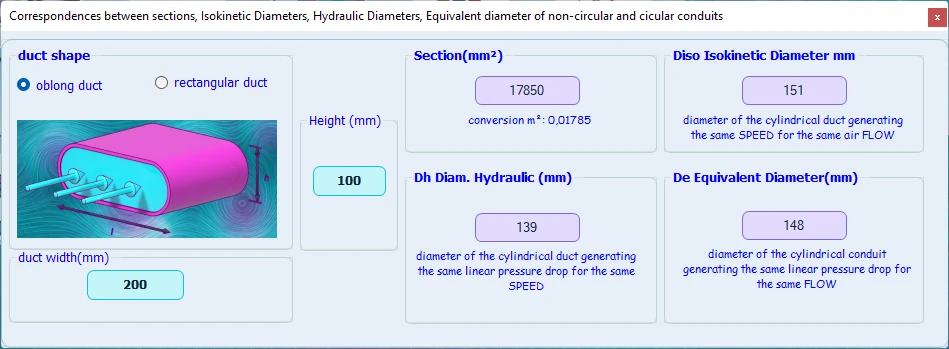
Conversion equivalent hydraulic diameters and the isokinetic mecaflux software.
To calculate the pressure loss of a linear conduit of rectangular or oblong cross section:
- When the specification imposes on us the speed: DH is used (hydraulic diameter). Ex:A fluid flows 2 m/sec in a rectangular duct 200 x 100, the pressure drop is calculated as for a pipe diameter 133 by selecting in the tab major head loss, "I prefer to enter the speed", and entering speed 2 m/sec .
- De is used (equivalent diameter). Ex:A fluid flows at 2 m3h in a rectangular duct 200 x 100, the pressure drop is calculated as for a pipe diameter 152 selecting and entering the flow 2 m3h in the major loss tab.
The isokinetic diameter is informative, When the pipe is evaluated , Ex: we know that our conduct must convey the same flow at the same speed as in a pipe of 160 mm diameter, dimensions 200 x 100 will be applied to keep this operating.
calculate flues and smoke duct
Sizing of the fluid conduits (hydraulic ventilation)
Frequently asked questions
When should I use the hydraulic diameter rather than the equivalent diameter?
The hydraulic diameter when the velocity is the given: enter it with the actual velocity in the head loss formula (Reynolds and relative roughness computed on Dh). The equivalent diameter when the flow rate is the given: enter it with the actual flow rate and the round-pipe calculation directly gives the right friction loss per metre. Using Dh with the flow rate would underestimate the head loss by about 25 % on a 200 × 100 duct.
What is the equivalent diameter of a flat oval duct?
For a flat oval of major axis a and minor axis b, the area is S = π b²/4 + b (a − b) and the perimeter P = π b + 2 (a − b). The hydraulic diameter is 4 S / P and the equivalent diameter De = 1.55 S0.625 / P0.25 (S in mm², P in mm). For a 300 × 150 flat oval: S = 40,170 mm², P = 771 mm, Dh = 208 mm, De = 222 mm.
Why does a rectangular duct have more head loss than a round one?
For the same area the rectangle has more perimeter, hence more wall in friction, and its corners harbour dead zones. A 200 × 100 duct (200 cm²) carries the same flow at the same velocity as a 160 mm round duct, but behaves like a 152 mm round duct: its friction loss per metre is about 30 % higher. The ratio a/b is kept to 4 at most, and round ducts are preferred whenever space allows.
How do I calculate the head losses of the rectangular ducts of my own network?
In Mecaflux Standard the equivalent diameter conversion window is built into the setting of each duct: you state a circular, rectangular or flat oval section and the software computes Dh, De and Diso, then applies the right diameter depending on whether you enter the velocity or the flow rate in the major head loss tab; the inventory then adds up every run and fitting. For a ventilation or smoke extraction network to size, Mecaflux carries out the study of your project, or offers training on the software applied to your own installation.